Last updated June 2025
We started working in Ghana in 2006. To date, we have partnered with communities across 40 districts to implement projects focused on hospital strengthening, community eye health, integrated eye health and disease control. Our programs are designed to provide a full range of eye health care services, allowing us to address common eye conditions such as cataract and uncorrected refractive error, as well as more complex cases such as diabetic retinopathy and glaucoma.
In 2024, we launched two new Hospital-Based Community Eye Health Projects in partnership with Winneba Municipal Health Directorate and Winneba Municipal Hospital, and with Ajumako Enyan Essiam District Health Directorate and Ajumako District Hospital. We trained the hospitals’ ophthalmic personnel, physician assistants, midwives and community health nurses in primary eye care, as part of our work to integrate eye care into primary health care.
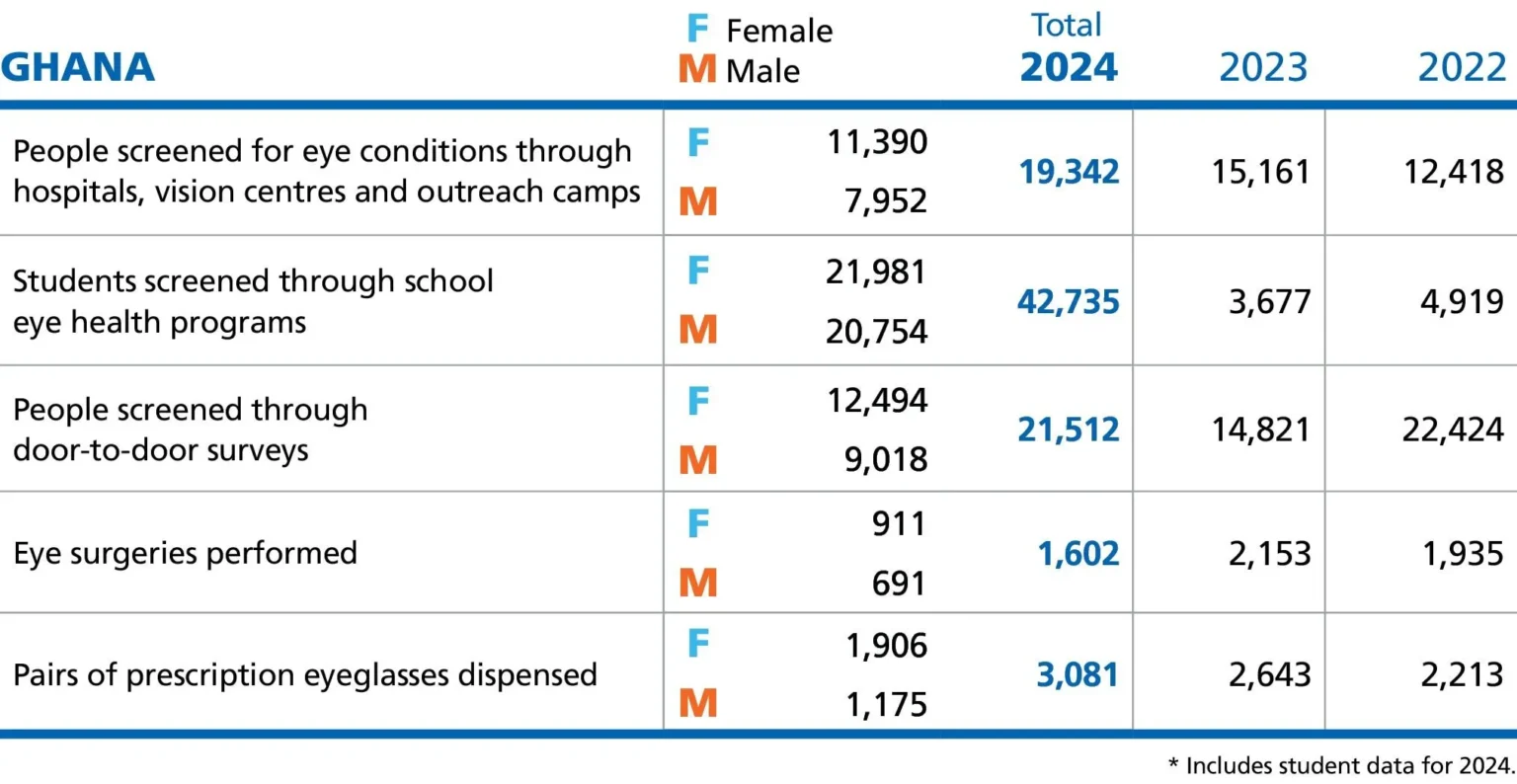
Our disease control programs saw us disperse 3,081 pairs of eyeglasses, including 1,244 pairs for students. After a shipment delay in 2023, we worked tirelessly to address the backlog while also fulfilling 2024 orders. This attributed to a 17 per cent increase in dispensed eyeglasses compared to 2023.
Meanwhile, we conducted a research study on refractive errors in students using data from our school eye heath program, supported by Latter-day Saint Charities and implemented in partnership with Ghana Education Service... Read more in our 2024 Annual Report
We established Watborg Eye Services in 2006 and the facility is operated by Dr. Boateng Wiafe, our technical advisor. Dr. Bo has completed thousands of cataract surgeries and provided training for hundreds of eye health care personnel in Africa.
Dr. Bo also served as principal investigator and lead researcher for the first ever Blindness and Vision Impairment study in Ghana, commissioned by Operation Eyesight. We developed a methodology and approach that is reliable and cost-effective, working with Ghana Health Service and other partners. The findings of this study helped us to determine the prevalence of blindness and vision impairment in Ghana, and plan and advocate for eye health in the country.