Updated June 2025
With one of the largest populations living below the poverty line in the world, India is home to 15 million people who are blind.
Tragically, 90 per cent of cases are preventable or treatable.
In India, 65 per cent of eye surgeries occur in the private or voluntary sector, while only 35 per cent are provided in government hospitals. Through our partnership with India’s government at the national and state levels, we are helping make primary care available to more people through India’s primary care system.
We are in our 61st year of preventing blindness and restoring sight in India, where we have partnered with communities in 90 districts across 17 states. Through our network of more than 31 partner hospitals and 114 vision centres, we are focused on:
In 2024, our community eye health work included relaunching 11 community eye health projects that were suspended due to COVID-19, declaring 197 villages Avoidable Blindness-Free, training 759 frontline workers including community health volunteers in primary eye care, and reaching 457,577 people through health education and awareness activities.
Our hospital strengthening work included upgrading one operation theatre and providing refresher training to 79 ophthalmic personnel in the state of Madhya Pradesh, strengthening one Retinopathy of Prematurity sub-specialty department in Uttar Pradesh, beginning the construction of a secondary eye hospital in Karnataka and establishing seven vision centres.
Back in 2021, we launched our first Integrated People-centred Eye Care (IPEC) project in India, in partnership with the state government of Arunachal Pradesh. The objective was to make eye health-care services available to underserved populations by integrating primary eye care into pre-existing primary health-care facilities. Based on the success of this model, we scaled this project to include additional states.
In 2024, we implemented four IPEC projects: two in Arunachal Pradesh, one in Madhya Pradesh and one in Meghalaya. In total, we upgraded 199 government health centres to include vision care facilities. We also handed over two mobile eye vans, enabling us to increase the number of people screened through outreach camps in Meghalaya and to double the number of cataract surgeries in Singrauli, Arunachal Pradesh.
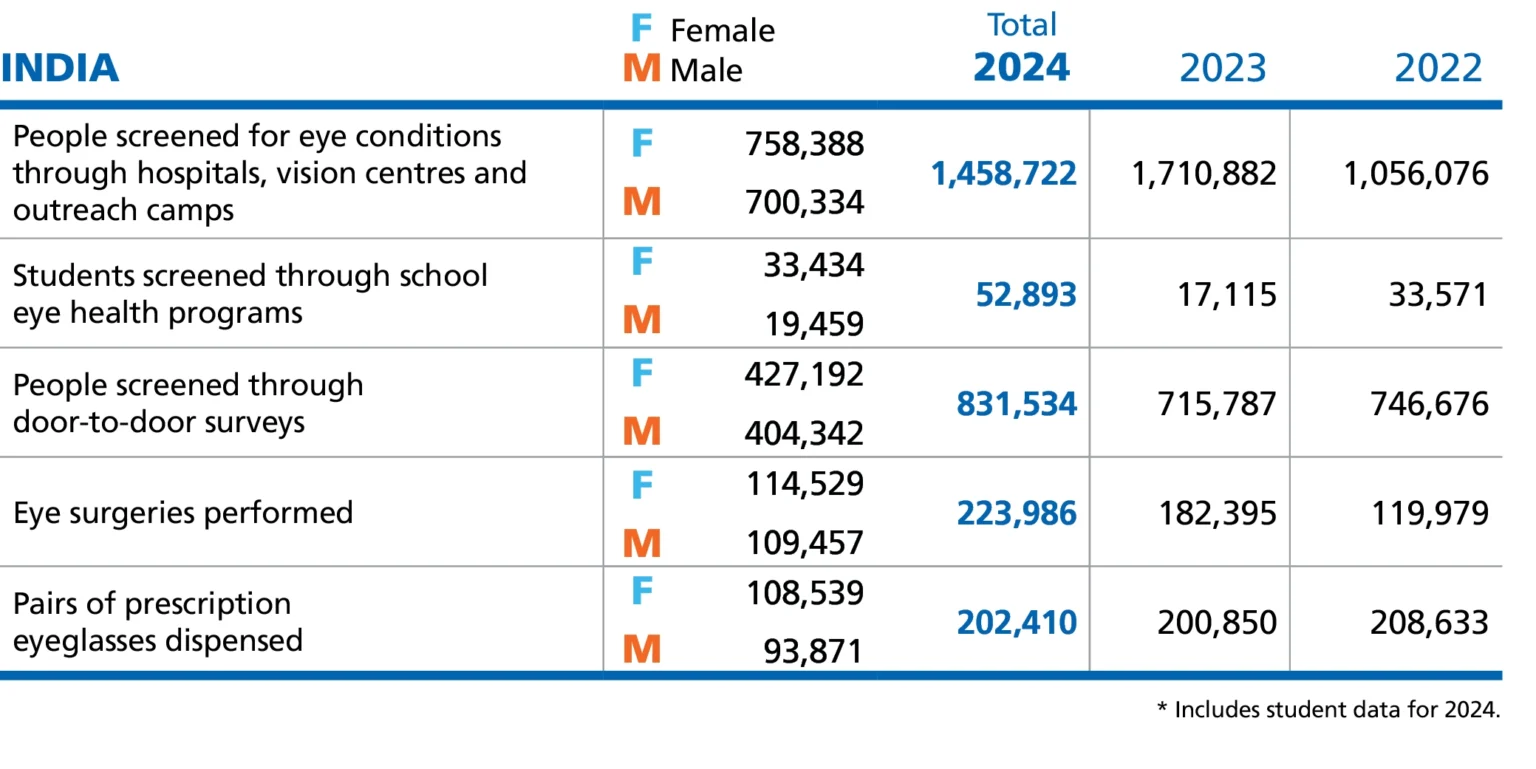
Through our disease control programs, we launched a district-wide school eye screening program for 330 schools. Through school eye health programs, we screened 52,893 students from 116 schools and dispensed 895 pairs of eyeglasses.
We launched two research studies in partnership with the Pragyaan Sustainable Health Outcomes Foundation: one to evaluate our survey tools, and the other to evaluate our approach to declaring villages as Avoidable Blindness-Free on a sustainable basis. We look forward to sharing our findings