We expanded our Hospital-Based Community Eye Health Program into Nepal in 2016. We first worked in Nepal in 1973, when we established the Nepal Eye Hospital in Kathmandu, the country’s first full-fledged eye hospital. Before leaving the country, we played an instrumental role in establishing and/or strengthening five other eye hospitals in Nepal. After leaving to focus our blindness prevention programs in more urgently needed areas, our support was requested again. Today, we partner with Nepal Eye Hospital and Fateh-Bal Eye Hospital in Nepalgunj. We began partnering with communities in Bangladesh in 2018.
Our current partners are Symbiosis Bangladesh, which works to alleviate poverty and empower the development of community-based organizations, and the Dr. K. Zaman BNSB Eye Hospital, which provides eye health care for people from all walks of life.
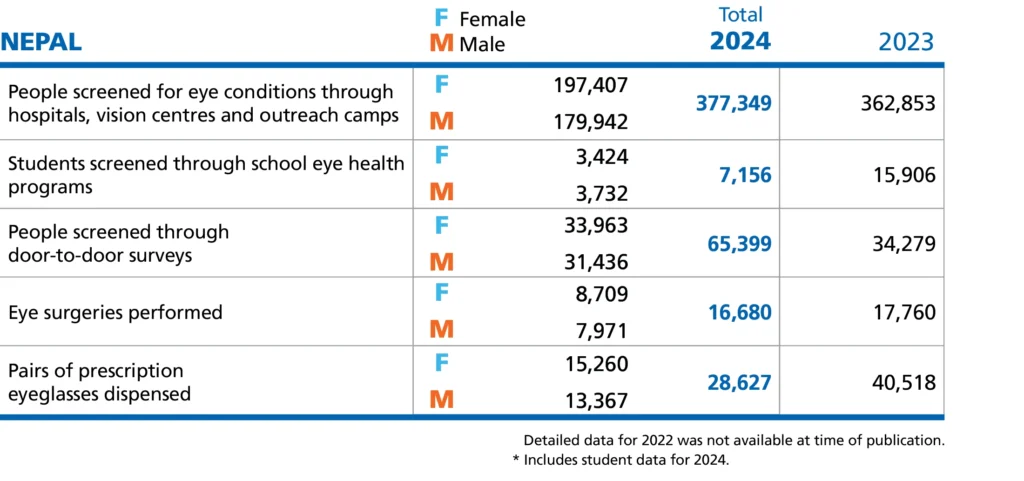
In 2024, our highlights included hospital strengthening that led to successful surgeries resulting in vision recovery (measured through visual acuity metrics). We confirmed quality eye health-care service in our three vision centres, conducted door-to-door surveys of 27,207 people, and implemented public health education and awareness raising activities that reached 17,080 people.
Through integrated eye health, we linked 1,879 children under five years of age to primary health centres for immunization and 61 expectant women and nursing mothers to primary health centres.
Pivoting two of our projects
Two of our vision centre projects are being implemented in partnership with another non-governmental organization. The vision centres are in their field offices, which are remote. While this arrangement minimizes the cost of rent, the remoteness of these facilities has made it difficult to reach our targets for dispersing eyeglasses and performing cataract surgeries. We have now shifted to becoming a non-financial technical partner in this project, and we will assess the project after one year. A non-financial technical partnership is an agreement where we provide technical expertise without funding.
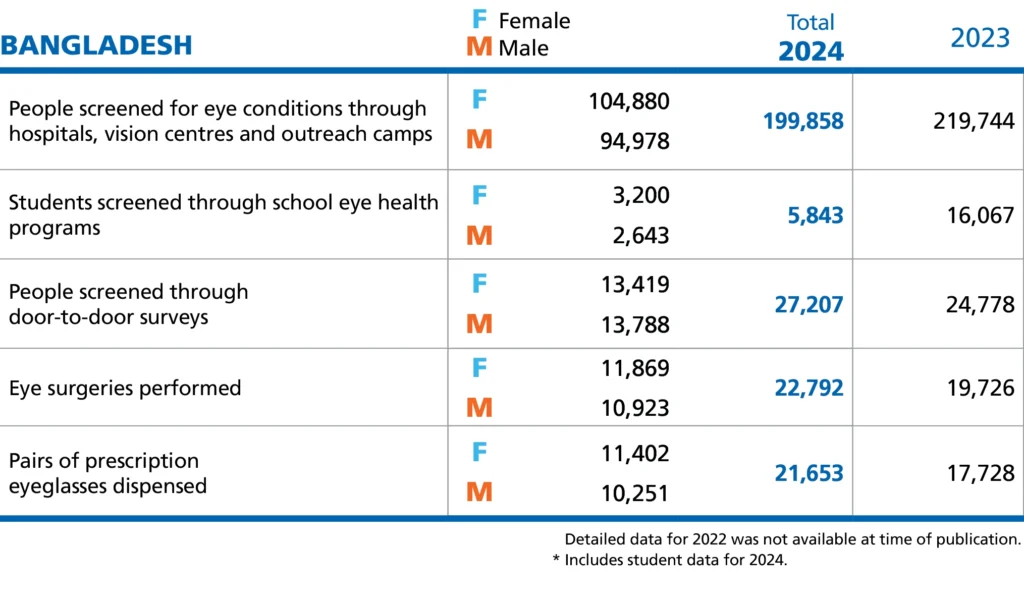
In 2024, our highlights included hospital strengthening that led to successful surgeries resulting in vision recovery (measured through visual acuity metrics). We confirmed quality eye health-care service in our three vision centres, conducted door-to-door surveys of 27,207 people, and implemented public health education and awareness raising activities that reached 17,080 people.
Through integrated eye health, we linked 1,879 children under five years of age to primary health centres for immunization and 61 expectant women and nursing mothers to primary health centres.
Pivoting two of our projects
Two of our vision centre projects are being implemented in partnership with another non-governmental organization. The vision centres are in their field offices, which are remote. While this arrangement minimizes the cost of rent, the remoteness of these facilities has made it difficult to reach our targets for dispersing eyeglasses and performing cataract surgeries. We have now shifted to becoming a non-financial technical partner in this project, and we will assess the project after one year. A non-financial technical partnership is an agreement where we provide technical expertise without funding.